
A scoliosis diagnosis – whether for a teenager or an adult – raises a lot of questions and often a fair amount of anxiety. Will it get worse? Does it need surgery? What can actually be done? At The Chiropractic Place in Montrose, scoliosis is something we evaluate and manage regularly, and the answer to most of those questions is more nuanced and more hopeful than many patients initially expect.
What Scoliosis Actually Is
Scoliosis is an abnormal lateral curvature of the spine – a sideways curve, often with a rotational component, that deviates from the spine’s normal vertical alignment. It’s measured in degrees using the Cobb angle on X-ray. Curves under 10 degrees are generally considered within normal variation. Curves between 10 and 25 degrees are mild. Curves between 25 and 40 degrees are moderate. Curves over 40-50 degrees are typically where surgical intervention is considered.
The majority of scoliosis cases – particularly those identified in adolescents – are in the mild to moderate range. Many never progress significantly, especially after skeletal maturity is reached. And for those cases, the question isn’t whether surgery is needed. It’s what conservative care can do to manage symptoms, slow progression, and maintain function.
Types of Scoliosis
Adolescent Idiopathic Scoliosis
The most common type, typically identified between ages 10 and 18. “Idiopathic” means the cause isn’t fully understood, though genetic factors play a role. It’s more common in girls and tends to progress most rapidly during growth spurts. Early identification is valuable because intervention during the growth years has more influence on the curve’s trajectory than intervention after skeletal maturity.
Adult Degenerative Scoliosis
In adults, scoliosis can develop gradually as asymmetrical disc degeneration and vertebral wear create a slow lateral shift in spinal alignment. This type tends to cause more significant pain than adolescent scoliosis because it’s often accompanied by nerve compression, disc problems, and spinal stenosis. It’s increasingly common after age 50.
Functional Scoliosis
Sometimes what appears to be structural scoliosis is actually a functional curve – a lateral shift driven by muscle imbalance, leg length discrepancy, or pelvic misalignment rather than a fixed structural change in the vertebrae themselves. Functional scoliosis often responds very well to chiropractic care because addressing the underlying mechanical driver can significantly reduce or eliminate the curve.
What Chiropractic Care Can and Can’t Do for Scoliosis
We want to be straightforward here, because scoliosis is an area where realistic expectations matter.
Chiropractic care doesn’t straighten a structural scoliosis curve to normal. That’s not a claim we make, and you should be skeptical of any provider who does. What chiropractic care can do is meaningful:
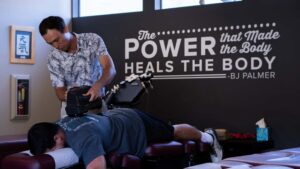
It can reduce pain and muscle tension associated with the abnormal curvature. Scoliosis creates asymmetrical loading on the spine that produces chronic muscle imbalance and joint irritation – and chiropractic adjustments address those mechanical consequences directly.
It can improve spinal mobility and reduce nerve interference in the affected segments. Even in a curved spine, the individual vertebral joints can be helped to move more freely – which reduces pain and supports better neurological function.
For functional scoliosis, it can address the underlying driver of the curve – pelvic misalignment, leg length discrepancy, muscle imbalance – in ways that reduce the curve itself, sometimes significantly.
And for adolescents who are still growing, maintaining spinal mobility and addressing postural contributors may support a more favorable progression compared to observation alone – though this is best managed in coordination with the patient’s orthopedic provider.
How We Evaluate Scoliosis at The Chiropractic Place
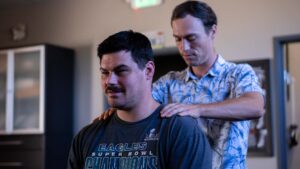
A thorough evaluation is the starting point. Dr. Brian Miller, DC, CCWP, FICPA, has been evaluating spinal curvature in patients of all ages throughout his 40+ years in Montrose. The examination includes a postural assessment, range of motion testing, palpation of the spinal segments, and X-rays when appropriate to measure the curve accurately and assess the structural characteristics involved.
Understanding the type, location, and severity of the curve – and whether there’s a functional component driving it – shapes the care approach entirely. A 14-year-old with a 20-degree adolescent idiopathic curve needs a different conversation than a 55-year-old with degenerative scoliosis causing nerve pain. We treat the patient, not the diagnosis.
Scoliosis in Children and Adolescents – A Note for Parents
If your child’s school screening flagged a possible scoliosis, or if you’ve noticed uneven shoulders, a prominent shoulder blade, or an asymmetrical waistline, getting an evaluation is the right call. Mild curves that are caught early are far easier to monitor and manage than those that are discovered after significant progression.
Dr. Brian’s FICPA certification reflects specific post-graduate training in pediatric spinal care. His approach to young patients is thorough, gentle, and appropriately calibrated for a developing spine. Many of the families in La Cañada and La Crescenta who bring their children to The Chiropractic Place for pediatric chiropractic care have done so after a scoliosis concern was identified – and have appreciated having a practitioner who takes it seriously without creating unnecessary alarm.
Cold Laser Therapy for Scoliosis-Related Pain
For patients whose scoliosis is causing significant muscle tension, inflammation, or nerve irritation, cold laser therapy can provide meaningful relief alongside adjustments. It reduces inflammation and supports tissue repair in the areas of the spine that are chronically overloaded by an asymmetrical curve – without any discomfort or recovery time.
Getting a Clear Picture of Your Spine in Montrose
If you’ve been told you or your child has scoliosis – or if you’ve noticed postural changes that concern you – come in and let us take a look. The Chiropractic Place has served Montrose, La Cañada, La Crescenta, and the Crescenta Valley for over 40 years, and we’d be glad to give you a clear, honest assessment of what’s happening and what can realistically be done about it.
Call us at (818) 249-2300 or visit our contact page to schedule. New patients can take advantage of our new patient special to get started with a complete evaluation.