Your first visit to a chiropractor in Montrose at The Chiropractic Place is not what most first-timers expect. There’s no cracking before you even sit down, no pressure to sign up for a long-term plan on the spot, and no mystery about what’s happening or why. What you get is a thorough evaluation, a clear explanation, and – if it’s the right fit – your first adjustment, all in one visit.
Why So Many People Put Off Their First Chiropractic Appointment
We hear this all the time. People have been dealing with back pain, neck stiffness, or headaches for months – sometimes years – before they finally call. When we ask why they waited, the answers are usually the same: they weren’t sure what chiropractic actually involved, they’d heard mixed things, or they were a little nervous about the adjustment itself.
All of that is completely understandable. And it’s exactly why we want to walk you through what actually happens, step by step, before you ever walk through the door on Honolulu Avenue.
Before Your Appointment: What to Bring and Know
You don’t need to bring much. If you have recent imaging – X-rays, MRIs, CT scans – bring those along. If you’ve seen other providers for the same issue, a brief summary of what was found and what was tried is helpful. But none of that is required to get started.
Wear comfortable clothing if possible. You’ll be moving through some range-of-motion assessments, and being able to move freely makes the exam easier for everyone.
If you’re a new patient taking advantage of our new patient special, plan to arrive a few minutes early to complete your intake paperwork. It covers your health history, current symptoms, and what’s been done for them previously.
Step 1: The Consultation
Your visit starts with a conversation. Dr. Brian Miller or Dr. Riley Miller will sit down with you and actually listen – to where the pain is, how long it’s been going on, what makes it better or worse, what you’ve tried, and what your health and activity goals are.
This part matters more than most patients realize. The goal isn’t just to locate the symptom. It’s to understand the full picture of what’s going on with your body so that the care you receive is targeted, not generic.
Dr. Brian has been doing this for over 40 years and has worked with everyone from professional athletes to touring musicians to multi-generational families in Montrose. Dr. Riley brings a sports performance and movement background with a TPI certification and a focus on how the body functions as a whole system. Between them, you’re getting a depth of perspective that’s rare in a single practice.
Step 2: The Physical Examination
After the consultation, you’ll go through a thorough physical examination. This typically includes:
Postural assessment. We look at how your spine lines up from the front, back, and side. Postural imbalances often reveal the source of pain before we’ve even touched the spine.
Range of motion testing. How far can you bend, rotate, and extend? Restrictions in movement tell us where things are stuck or guarded.
Orthopedic and neurological testing. These tests help identify whether nerves are involved – which is particularly important for conditions like sciatica, neck pain with arm involvement, or suspected disc problems.
Muscle and functional testing. We assess strength, reflexes, and how well specific muscle groups are firing – especially useful for athletes and active patients.
Spinal palpation. This is hands-on assessment of the spine itself – feeling for areas of restricted movement, tenderness, muscle tension, and misalignment.
Step 3: X-Rays (When Appropriate)
Not every patient needs X-rays on the first visit, but many do. When we take them, it’s because what we see in imaging meaningfully changes how we approach your care.
X-rays let us see the actual alignment of your spine, the condition of the disc spaces, any arthritic changes, and whether there’s anything structurally that needs to be factored into our technique. For patients with a history of injury, surgery, or significant or complex symptoms, that information is especially important.
If you’ve had recent imaging done elsewhere that’s relevant, we’ll review that rather than duplicate it unnecessarily.
Step 4: The Report of Findings
This is the part of the visit that surprises most new patients – in a good way.
Before any adjustment happens, we sit down with you and explain what we found. If we took X-rays, we go over them together. We explain what’s going on, why we think it’s happening, and what we recommend for care. We give you a realistic picture of what to expect, including how many visits may be appropriate based on your situation.
You’re never left guessing. And you’re never pressured into agreeing to anything before you understand it.
Step 5: Your First Adjustment
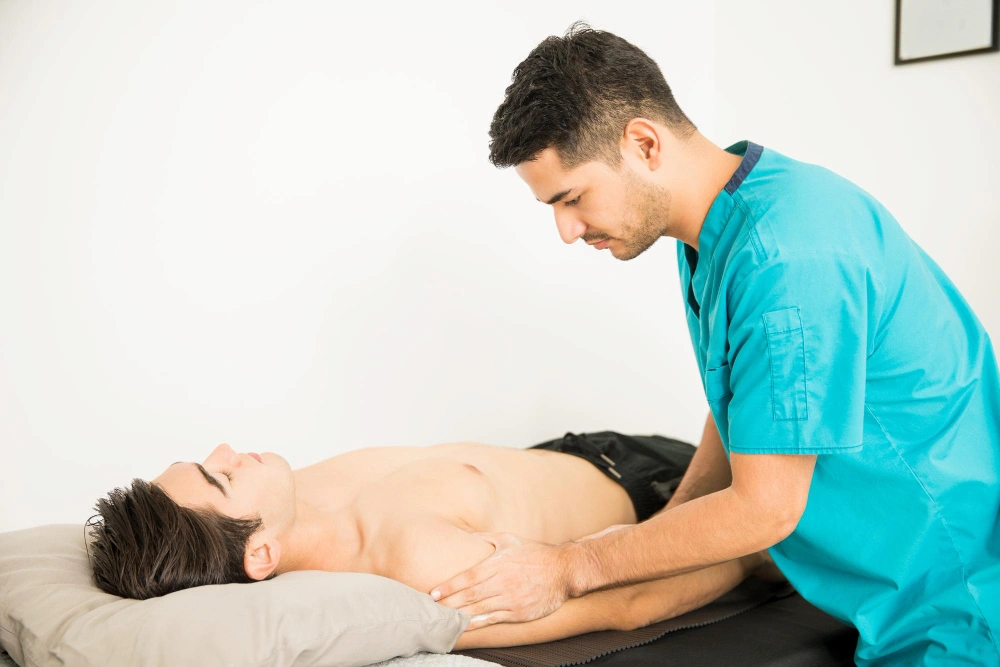
If the examination findings support it and you’re comfortable proceeding, your first chiropractic adjustment happens at this same visit.
We use multiple adjustment techniques at The Chiropractic Place – manual adjustments, instrument-assisted techniques using a handheld device, and others – depending on what’s most appropriate for your spine and your comfort level. If you’re nervous about any particular technique, say so. There are always options.
The adjustment itself is typically quick. Most patients feel immediate relief in some form – less tension, greater ease of movement, or a sense of decompression. Some people feel a little sore for a day or two afterward, similar to how muscles feel after a good workout. That’s normal and usually resolves quickly.

What Happens After Your First Visit
Before you leave, we’ll talk through next steps. Depending on what we found, that might mean a follow-up schedule of 2-3 visits per week initially, or something less frequent if your situation is more straightforward.
We also discuss our process for monitoring your progress over time. Care at The Chiropractic Place isn’t a revolving door. We’re tracking how you’re responding and adjusting the approach as needed.
If cold laser therapy would benefit your recovery – particularly for inflammation, nerve irritation, or tissue damage – we’ll discuss that as well. Cold laser therapy is available in our office and can be a meaningful addition to your care plan without adding complexity or recovery time.
Is Chiropractic Right for You?
Honestly, not every person we examine is a good fit for chiropractic care. If we find something that requires medical attention first – or if your condition is outside the scope of what we can help – we’ll tell you that directly and point you toward the right resource. Dr. Brian’s philosophy has always been to treat the patient, not just fill a schedule.
But for the vast majority of people dealing with back pain, neck pain, headaches, disc problems, and similar issues, chiropractic care is a safe, effective, and drug-free first step that most patients wish they’d taken sooner.
Ready to See What Your First Visit Looks Like?
Serving Montrose, La Cañada, La Crescenta, and the surrounding foothill communities, The Chiropractic Place has been the go-to practice for families in this area for over four decades. If you’re ready to find out what’s actually causing your pain – and what to do about it – we’d love to see you.
Call (818) 249-2300 or visit our contact page to schedule. First-time patients can take advantage of our new patient special – a complete evaluation and first adjustment for just $79.