
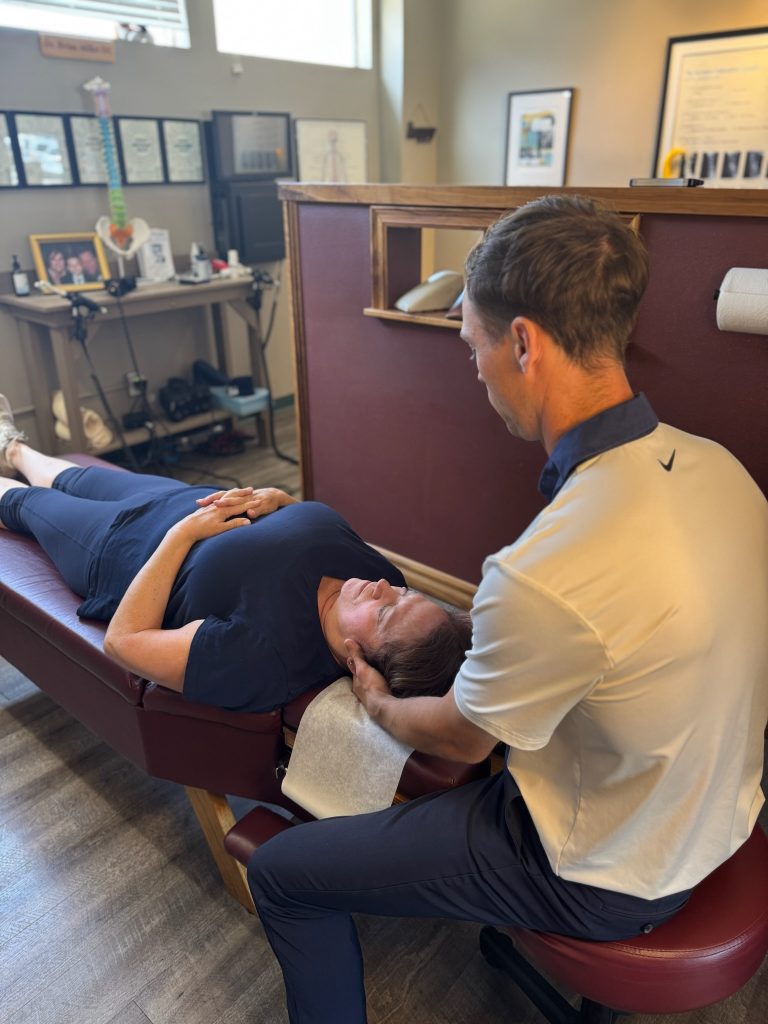
If your teenager spends hours a day on a phone – and most do – their neck is paying a price that’s only recently become clear. The forward head posture that comes from constant screen use is showing up in younger and younger spines, and at The Chiropractic Place in Montrose, we’re seeing the effects in teenagers who haven’t had a single injury. The good news is that adolescent spines are still developing, which means the right care now can change the trajectory before these patterns become permanent.
What “Text Neck” Actually Means for a Developing Spine
Text neck describes the posture almost everyone adopts when looking down at a phone: head tilted forward, chin tucked toward the chest, shoulders rounded. For an adult, this creates strain. For a teenager whose spine is still forming, the concern goes deeper – because sustained postural loads during the growth years can influence how the cervical spine actually develops.
The numbers are worth understanding. A human head weighs roughly 10 to 12 pounds in a neutral position. Tilt it forward to look at a phone, and the effective load on the neck climbs dramatically – at a 60-degree angle, the cervical spine is supporting the equivalent of around 60 pounds. Teenagers who spend four, five, or more hours a day in that position are loading their necks that way during the exact window when their spines are most adaptable.
Why Adolescent Spines Are Especially Vulnerable
During the teenage years, the spine is still growing and the soft tissues, growth plates, and vertebral structures are more responsive to the loads placed on them. That responsiveness is a double-edged sword. It means sustained poor posture can shape spinal development in unfavorable ways – but it also means that correcting posture during these years has more lasting influence than it would in a fully mature adult spine.
We’re seeing teenagers with reduced cervical curves, chronic upper back tension, and the kind of forward head posture that used to show up mainly in middle-aged desk workers. The difference is that these patterns are starting two or three decades earlier than they once did.
Signs Parents in Montrose Should Watch For
Most teenagers won’t volunteer that their neck hurts – they’ve normalized it. Parents often notice the signs before the teen mentions anything. Worth watching for:
Posture changes. A visibly forward head position, rounded shoulders, or a hunched appearance when sitting or standing – especially if it’s developed gradually over the past year or two.
Frequent headaches. Tension headaches and headaches originating at the base of the skull are commonly linked to forward head posture and the cervical strain it creates. If your teen is getting frequent headaches, screen posture is worth considering as a factor.
Neck and upper back complaints. Offhand comments about a stiff neck, sore shoulders, or upper back tightness – particularly at the end of the day or after long stretches on devices.
Reduced range of motion. Difficulty turning the head fully or stiffness when looking up, which can indicate developing cervical restriction.
How Chiropractic Care Helps Teenage Spines
The goal with teenagers isn’t just to relieve current discomfort – it’s to interrupt a developing pattern before it becomes a structural reality they carry into adulthood. At The Chiropractic Place, that starts with a thorough evaluation of the cervical and thoracic spine, posture, and range of motion, with imaging when appropriate to understand what’s actually happening structurally.
Chiropractic adjustments restore proper movement to restricted segments in the neck and upper back, reducing the muscle tension and neck pain that develop from sustained forward posture. For a developing spine, restoring normal motion and alignment supports healthier development during the years when it matters most.
Dr. Brian Miller, DC, CCWP, FICPA, holds a Fellowship with the International Chiropractic Pediatric Association, which reflects specific training in caring for younger patients. The techniques used with teenagers are appropriately gentle and calibrated to their developing spines – and many adolescents find the adjustments straightforward and even enjoyable once any initial nervousness passes.
What Teens Can Do Between Visits
Care in the office addresses the structural piece. Daily habits determine whether that work holds. A few changes that genuinely help teenagers:
Hold the phone higher. Raising the device to eye level instead of looking down dramatically reduces the forward head load. It feels awkward at first but becomes habit with practice.
Take screen breaks. Every 30 to 45 minutes, look up, roll the shoulders back, and move the neck through its range of motion. Even a brief reset interrupts the sustained loading pattern.
Set up homework and gaming stations thoughtfully. A laptop on the lap or a phone on the bed forces the worst posture. A proper desk with the screen at eye level makes a real difference over the hours teens spend on schoolwork and games.
We’ll give specific guidance based on what we find in each teen’s evaluation, because the right approach depends on their individual posture and spinal pattern.
A Word to Parents
It’s easy to feel like fighting screen time is a losing battle – and we’re not suggesting you eliminate it. Phones and devices are part of teenage life now. The realistic goal isn’t elimination; it’s reducing the postural cost of the time they do spend on screens, and addressing the physical patterns that have already developed.
Catching and correcting these issues during adolescence is far easier than dealing with the entrenched version of the same problem twenty years later. The teens we see now have a real advantage in that their spines are still adaptable.
Supporting Healthy Spines in Montrose and the Crescenta Valley
The Chiropractic Place has cared for families across Montrose, La Cañada, and La Crescenta for over 40 years – often across multiple generations. If you’ve noticed your teenager’s posture changing, or they’re complaining of headaches or neck tension, it’s worth having their spine evaluated.
Call us at (818) 249-2300 or visit our contact page to schedule. New patients are welcome and can take advantage of our new patient special to get started.