
The trails above Montrose and La Cañada – winding through the foothills and up into the Angeles National Forest – draw hikers year-round. It’s one of the genuine advantages of living in the Crescenta Valley: world-class hiking is minutes from your front door. But hiking, for all its benefits, places real demands on the spine, hips, knees, and ankles – and when something goes wrong on the trail, getting the right care quickly makes a significant difference in how fast you’re back out there.
Why Hiking Is Harder on the Body Than Most People Expect
Hiking looks low-impact compared to running or contact sports. In terms of joint load, it’s more demanding than it appears. Descending steep terrain – which is unavoidable on most local trails – places two to three times body weight through the knees with each downhill step. Uneven surfaces require constant micro-adjustments from the ankles, hips, and spine. And carrying a pack, even a light one, loads the lumbar spine and changes the body’s center of gravity in ways that stress the lower back over several hours.
Most hiking injuries don’t come from a single catastrophic event. They develop gradually – from repetitive load on a joint that was already slightly restricted, from a cumulative spinal stress that builds over a long day on the trail, or from a compensatory movement pattern that protects a tight hip by overloading the opposite knee. Understanding that pattern helps explain why the same hike that felt fine three months ago now produces knee pain or lower back stiffness that lingers for days.
Common Hiking Injuries We Treat in Montrose
Lower Back Pain and Stiffness
The most frequent complaint after a long hike – especially one with significant elevation gain – is lower back pain that appears during the hike or the day after. Uphill hiking extends the lumbar spine and compresses the facet joints. Downhill hiking flexes the spine repeatedly under load. Either pattern can aggravate existing lumbar restrictions or create new ones.
When lower back pain after hiking is consistent or worsening, it signals a structural issue worth addressing – not just post-hike soreness to stretch out.
Knee Pain
IT band syndrome, patellofemoral pain, and general knee soreness are extremely common in hikers, particularly those who do a lot of downhill mileage. These conditions have both local causes – tight IT band, weak VMO, inflamed bursa – and upstream mechanical contributors in the hip, pelvis, and lumbar spine. Treating only the knee without addressing the spinal and pelvic mechanics driving abnormal knee loading explains why many hikers deal with the same knee problem repeatedly.
Hip and SI Joint Pain
Sacroiliac joint dysfunction is a frequent finding in hikers who carry packs or walk long distances on uneven terrain. The rotational demands of trail hiking, combined with the asymmetrical load of a pack, can stress the SI joints and create the characteristic deep, one-sided lower back and buttock pain that worsens with prolonged walking or transitional movements.
Ankle Sprains and Instability
Trail surfaces are unpredictable. Ankle rolls happen, and even minor sprains that aren’t properly treated often leave behind joint restrictions that reduce proprioception and increase the risk of re-injury. Hikers who’ve had repeated ankle sprains on the same side are typically dealing with an unresolved joint mechanics problem – not just weak ankles.
Neck and Upper Back Tightness
Hikers who spend time looking down at the trail – particularly on technical terrain – adopt a sustained forward-head position that loads the cervical spine significantly. Add a pack with shoulder straps that pull the shoulders forward and restrict thoracic movement, and upper back and neck tightness after long hikes becomes predictable.
How Chiropractic Care Helps Hiking Injuries
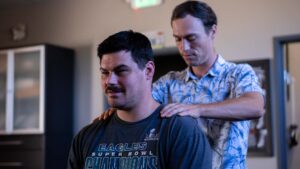
At The Chiropractic Place, chiropractic care for hiking injuries starts with identifying both the local problem and the mechanical factors contributing to it. Dr. Riley Miller’s movement screening background and TPI-based approach to evaluating how the whole body functions together is particularly relevant here – hiking injuries rarely exist in isolation from the broader movement pattern that created them.
Dr. Brian Miller’s four decades of treating active patients – including professional athletes and performers who rely on their physical function – bring deep clinical experience to sports and activity-related injuries of every kind.
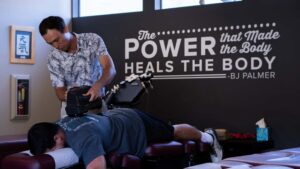
Spinal adjustments address lumbar, thoracic, and cervical restrictions that develop from trail demands. Extremity adjustments to the hip, knee, or ankle address joint-specific restrictions. And for patients with inflammation from a recent injury or overuse, cold laser therapy accelerates tissue healing and reduces swelling without any downtime – which matters for hikers who want to get back on the trail as quickly as possible.
Getting Back on the Trail – and Staying There
One of the most common things we hear from hiking patients at The Chiropractic Place is that they came in after an injury and discovered that previous limitations – a knee that always ached on downhills, a hip that tightened up after long hikes – also improved. That’s the result of addressing the structural contributors that were quietly loading those joints beyond their tolerance.
The goal of care isn’t just to resolve the acute injury. It’s to restore the mechanical foundation that lets you hike harder, longer, and with less pain than before.
Local Trails, Local Care
The trails above Montrose and La Cañada – Strawberry Peak, Mount Lukens, the Gabrielino Trail, and dozens of other routes through the San Gabriel Mountains – are part of what makes living in the Crescenta Valley special. The Chiropractic Place has been part of this community for over 40 years, caring for the active adults, families, and athletes who make those trails a regular part of their lives.
If a hiking injury is keeping you off the trail – or if the same aches keep showing up every time you go out – call us at (818) 249-2300 or visit our contact page to schedule. New patients can take advantage of our new patient special to get a complete evaluation and first adjustment.